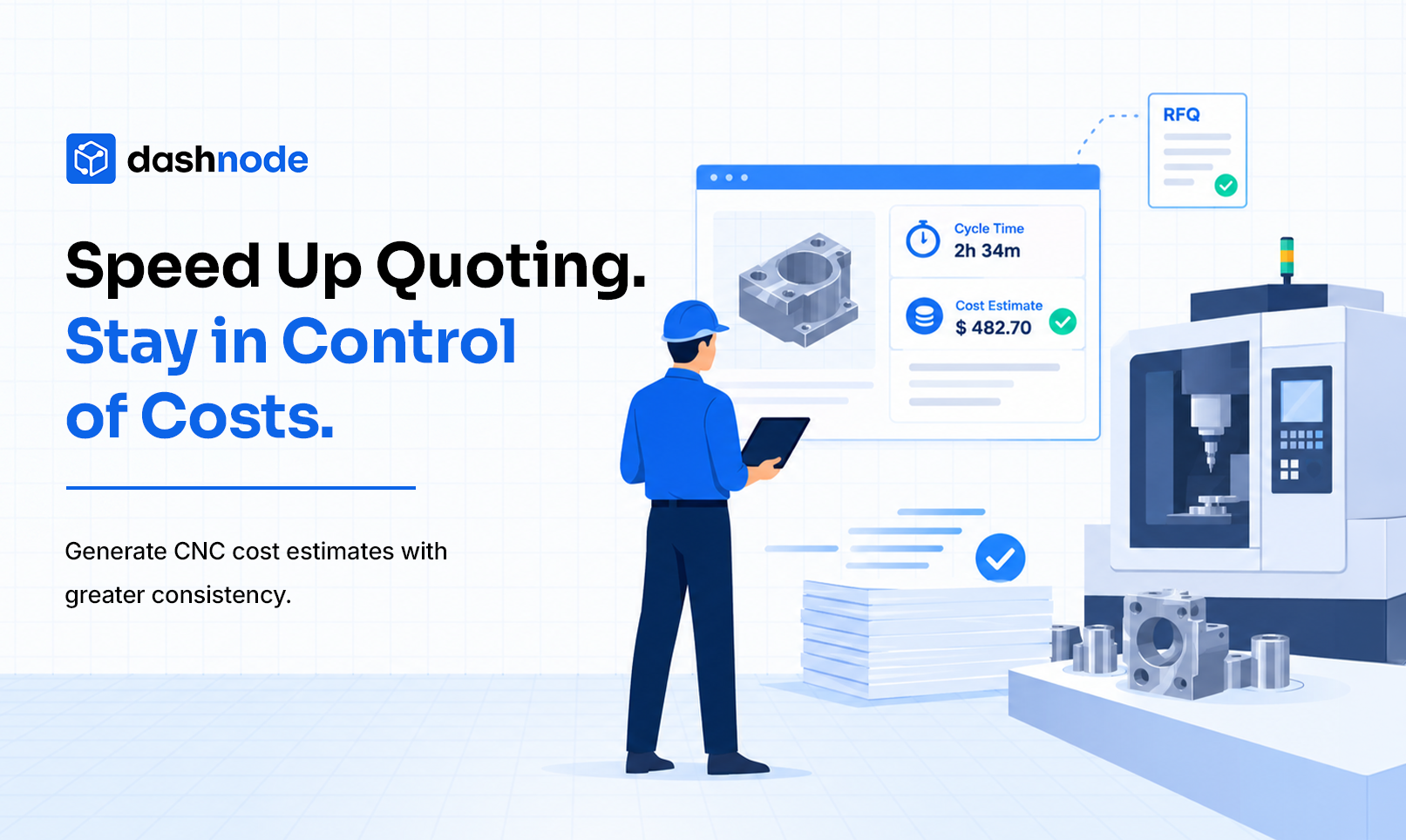
An instant CNC quote is an automated cost estimate for manufacturing a CNC-machined part, typically based on CAD geometry, material specifications, order quantity, machining time, and configured costing parameters. It helps manufacturers estimate production costs faster and respond to customer enquiries more efficiently.
Dashnode helps manufacturers streamline CNC cost estimation by analysing CAD files and applying configured costing inputs to support faster, more consistent estimates for milling, turning, and turn-mill components.
However, the accuracy of an instant CNC quote depends on the information available, the costing model, and the manufacturing requirements considered. Understanding its cost components and limitations helps manufacturers assess estimates and make informed pricing decisions.
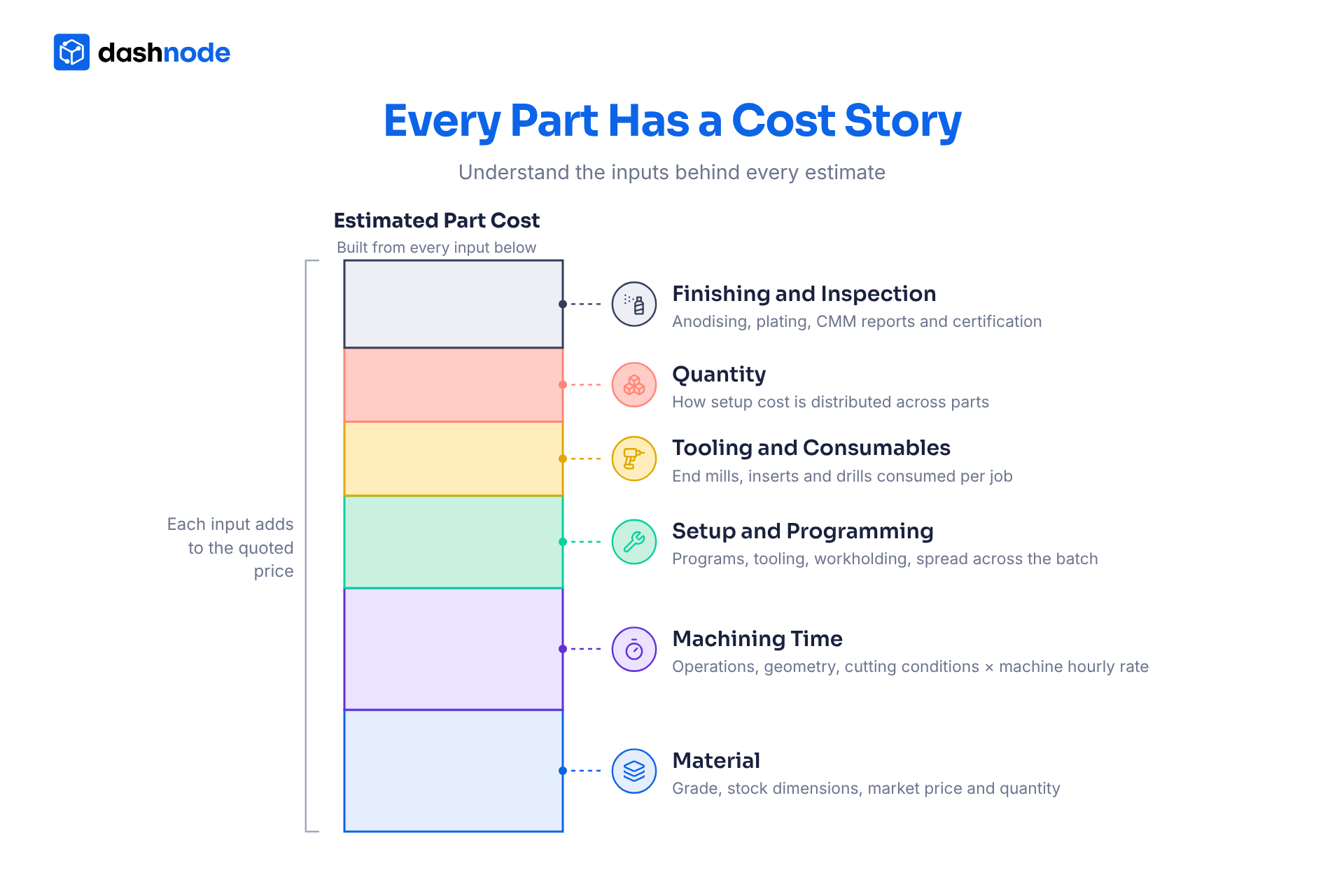
The cost components of an instant CNC quote depend on the quoting system and its configured rules. A comprehensive estimate should account for the relevant material, machining, setup, and production requirements.
Material cost depends on the selected grade, stock dimensions, market price, and quantity required. For example, machining a component from aluminium costs differently than machining the same component from stainless steel.
The finished part's volume does not necessarily reflect the amount of material a shop must purchase. Stock dimensions, machining allowances, work holding requirements, and material removed during production can all affect the estimate.
A reliable CNC machining cost estimate therefore needs the correct material specification and a costing method that reflects the stock required for the job.
Machining time is a major driver of CNC manufacturing cost. The estimate depends on the operations required, the part's geometry, material machinability, cutting conditions, and the selected machining strategy.
Milling, turning, drilling, and tapping have different time requirements. A component with deep pockets, complex profiles, or multiple setups may require more machine time than a simpler part of similar dimensions.
The estimated machine time is multiplied by the applicable machine hourly rate. Depending on the shop's costing model, this rate may account for equipment costs, maintenance, energy, depreciation, and allocated labour or other operating expenses.
Accurate estimates require realistic cycle-time assumptions and machine rates that reflect the shop's operating conditions.
Before production begins, the shop may need to prepare CNC programs, select cutting tools, configure workholding, establish work offsets, and set up the machine.
These activities consume time regardless of how quickly the machine produces each part. They matter most for prototypes and small production runs, where preparation costs spread across fewer units.
Manufacturers typically allocate setup and programming costs across the order quantity to calculate the per-part cost. A quote that accounts for machining time but overlooks setup can underestimate the cost of a low-volume order.
Cutting tools, inserts, drills, end mills, and other consumables contribute to machining costs. Their consumption depends on the material, operations, tool life, and machining requirements.
Harder materials and demanding geometries may increase tool wear or require specialised tooling.
Some manufacturers include typical tooling consumption in their machine hourly rates, while others calculate it separately. Either method can work if the costing model applies it consistently and avoids omissions or double-counting.
Order quantity affects how setup costs are distributed across parts. A prototype may have a higher unit cost than a repeat order for the same component because preparation costs are spread across fewer units.
Batch size, machine availability, production sequencing, and repeatability can also influence manufacturing efficiency.
An instant CNC quote should therefore use the requested quantity and appropriate production assumptions. A price calculated for one part may not reflect the economics of a larger production run.
Machining may represent only part of the work required to deliver a finished component. Customers may specify anodising, plating, polishing, heat treatment, dimensional inspection, material certification, or additional documentation.
These requirements affect cost and may influence lead time. Their inclusion in an instant CNC quote depends on the system's available inputs and configured scope.
Manufacturers should confirm whether the estimate covers the complete manufacturing requirement or whether certain operations need separate costing.

An instant CNC quote may rely on assumptions that require further validation. Four areas deserve particular attention.
A 3D CAD model provides geometric information, but it may not communicate every manufacturing requirement. Material grades, critical tolerances, surface finishes, heat treatment, and inspection criteria may appear in technical drawings or purchase orders instead.
If the quoting workflow does not capture these details, the estimate may cover only part of the manufacturing scope.
What to check: Confirm the CAD revision, material, quantity, tolerances, finishing requirements, and relevant drawing specifications.
Parts with similar dimensions can require different tools, operations, workholding arrangements, and machining times. Deep pockets, difficult-to-reach features, and complex profiles may require additional tool changes or setups.
A costing model that relies on limited geometric information may not capture every manufacturing constraint.
What to check: Understand how the system estimates cycle time, which operations it recognises, and when engineering review is necessary.
A quote may calculate machining costs without clearly accounting for setup, programming, finishing, heat treatment, or outsourced processes. This can distort comparisons between prototype and production orders or leave part of the delivery requirement unpriced.
What to check: Verify how the system allocates setup costs across quantities and whether the estimate includes all required secondary operations.
Material prices, tooling costs, and machine hourly rates change over time. Cycle-time assumptions may also become inaccurate as manufacturing processes evolve.
Even a well-configured quoting system can produce unreliable estimates when its underlying data no longer reflects shop conditions.
What to check: Review costing parameters periodically and compare estimates with actual production costs to identify and correct recurring discrepancies.
Manufacturers should assess an instant CNC quote by reviewing its inputs, assumptions, and cost components rather than judging it solely by the final price.
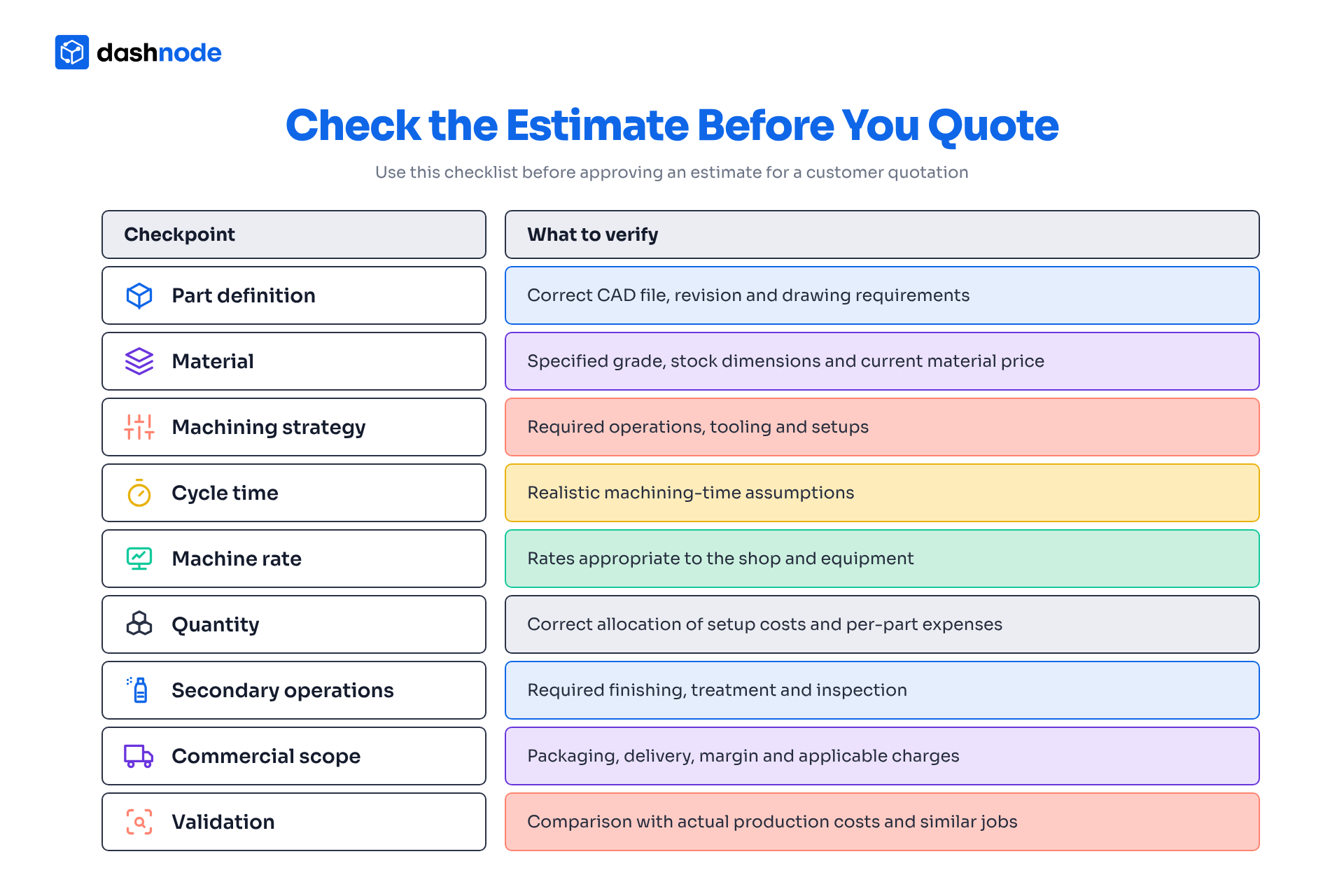
Historical production data can help manufacturers evaluate estimates more objectively. Compare quoted costs with completed jobs involving similar materials, geometries, operations, and quantities.
If estimates consistently differ from actual costs, investigate the assumptions responsible. The discrepancy may stem from inaccurate cycle times, material usage, setup allocation, or outdated costing parameters.
No automated estimate is universally accurate across every part and production environment. The objective is to establish a repeatable process for assessing and improving estimate quality.
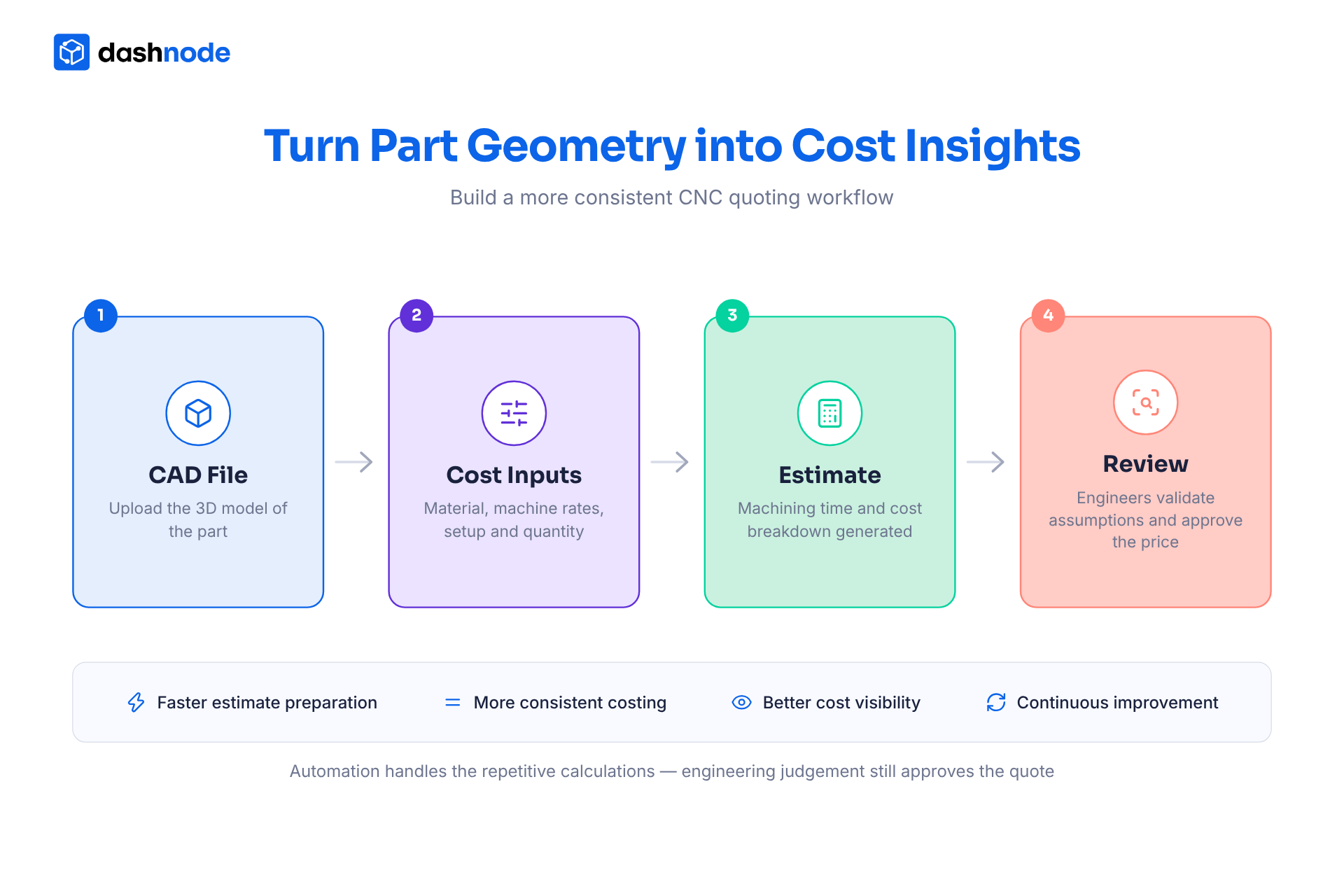
Manual estimation often requires an estimator to review CAD files, interpret drawings, calculate material requirements, estimate machining time, and enter figures into spreadsheets or other costing tools.
Although this approach can work for complex jobs requiring detailed engineering judgement, repetitive calculations and inconsistent data entry can slow down routine quoting.
Automated CNC costing software can streamline selected stages of the process. Depending on its capabilities, it can analyse CAD geometry, derive relevant part information, apply configured material and machine rates, and support machining-time and production-cost estimation.
A structured costing workflow offers several advantages:
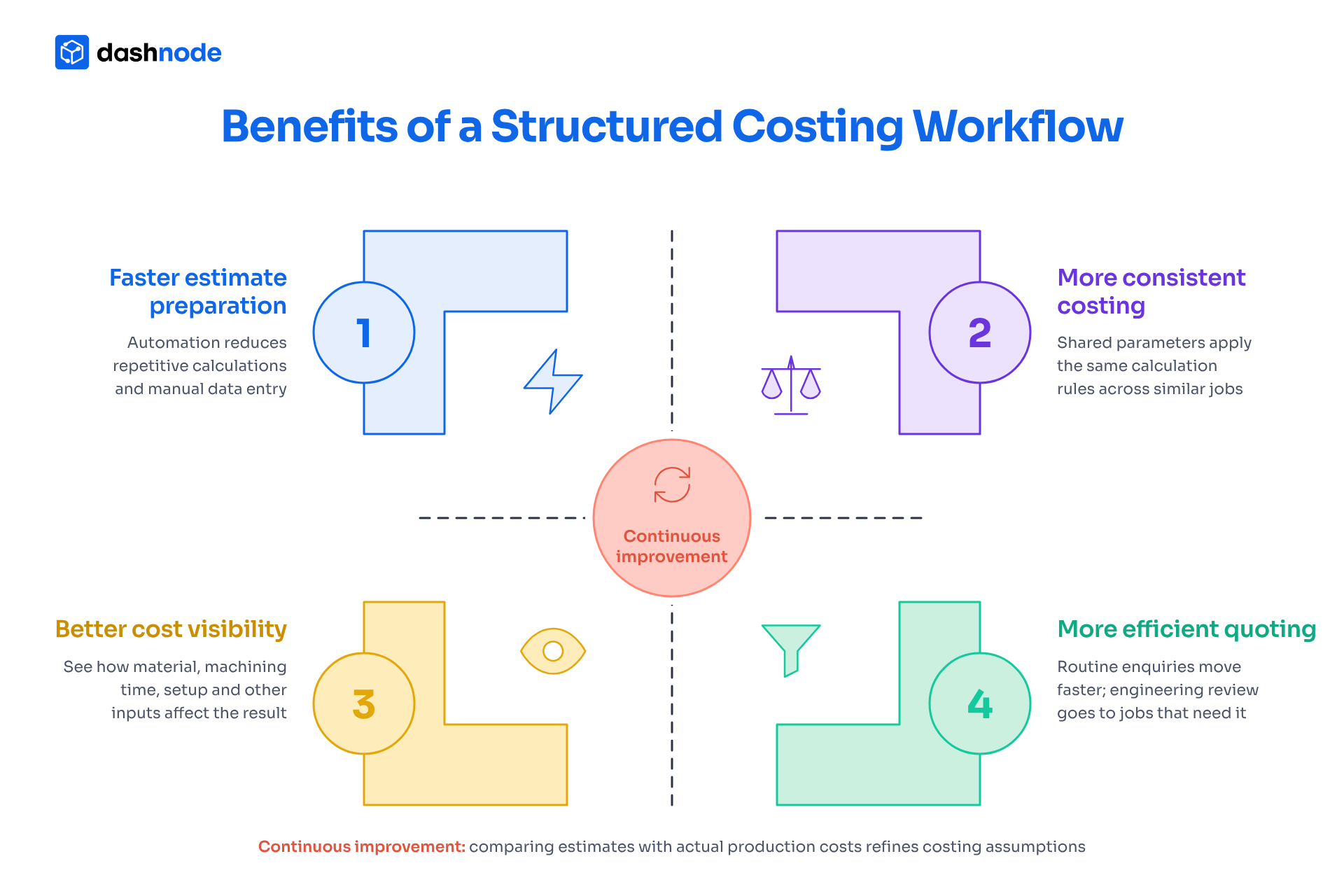
Automation still depends on input quality and the suitability of its costing model. Engineering expertise remains essential for parts with unusual geometry, demanding tolerances, specialised tooling, or uncertain manufacturing requirements.
The most effective approach combines automated calculations with clear review criteria, letting routine jobs follow a consistent process while exceptions receive extra attention.
Dashnode is CNC costing software that supports CAD-based machining cost estimation. It analyses CAD files and applies configured costing inputs to help manufacturers structure estimates around part geometry and relevant manufacturing parameters.
For CNC milling, turning, and turn-mill components, this approach reduces repetitive manual calculations and supports more consistent estimates. Material requirements, machining operations, machine hourly rates, and cycle-time assumptions remain important inputs to the costing process.
Dashnode helps manufacturers streamline estimation, while engineering and commercial teams remain responsible for reviewing assumptions, confirming manufacturing requirements, and approving the final customer price.
For shops that rely on spreadsheets or disconnected calculations, a structured costing workflow can provide a more repeatable foundation for preparing CNC quotes.
Want to see how CAD-based CNC cost estimation works in practice? Book a free demo with Dashnode to explore how it can support your quoting workflow.
Accuracy depends on the quality of the CAD data, the completeness of the manufacturing requirements, the costing model, and the underlying parameters. Manufacturers should validate estimates against engineering requirements and actual production costs, particularly for complex or unfamiliar parts.
Key factors include material grade and stock requirements, machining operations, cycle time, machine hourly rate, setup and programming, tooling, order quantity, finishing, inspection, and other applicable production costs.
It can account for many relevant costs when the system supports the required inputs and the manufacturer configures it appropriately. Some requirements may need separate costing or engineering review, so manufacturers should confirm what the estimate includes and excludes.
CAD-based costing can derive relevant geometric inputs from a 3D model and use them within a structured estimation process. This can reduce manual data entry, improve consistency, and help estimators prepare quotes faster. Results still depend on the system's capabilities and manufacturing assumptions.
Dashnode supports CAD-based CNC cost estimation by analysing part geometry and applying configured costing inputs. It helps manufacturers streamline repetitive estimation tasks and standardise calculations, while engineering teams review manufacturing requirements and validate the final quote.